


Bimonthly Membership Meeting
Wednesday, October 7, 2026
7:30 PM -- 9:30 PM
Hybrid Meeting Originating from Beechwood Farms in Pittsburgh, Pennsylvania
38 members were in attendance, in-person, at 3RBC's October membership meeting, held in the auditorium of Audubon Society of Western Pennsylvania's Beechwood Farms Nature Reserve. In addition to those attending in-person, 23 computers were logged on to the meeting via Zoom, with some shared by more than one person. In total, more than 61 individuals viewed the meeting, which started with our Annual Election of board members, and featured speaker Brian Shema, the Director of Operations at Audubon Society of Western Pennsylvania. His presentation was titled "Who Would Have Thunk: Chimneys are a Scarce Resource for Chimney Swifts."
President, Mike Fialkovich, called the Election Meeting to order at approximately 7:30 pm. Director Steve Thomas ran the election. Dave Brooke announced the three candidates: Conor Tompkins, John Dzikiy, and Clifford Bob. Steve asked the membership for a motion to approve these board member nominations. Jack Solomon made a motion to approve all nominees. The motion was seconded by numerous members. The board members were unanimously approved by the membership with no objections. New board members will begin their two-year term on January 1, 2027. Steve Thomas asked for a motion to close the election meeting. A motion to close the election meeting was given and seconded. This concluded the Annual Board Member Election.
- Mike Fialkovich began the members' meeting by thanking those who brought refreshments and snacks. Books had been recently donated to Three Rivers Birding Club following the passing of local librarian and archivist Charlie Aston, Jr., curator at University of Pittsburgh's Hillman Library. He previously allowed the club access to the Hillman Library's complete set of John Audubon's Birds of America. Mike explained that there has been a series of phishing email scams. Please disregard any emails asking for money or gift cards that are directed to you from accounts claiming to be board members.
- Treasurer Tom Moeller has finished the annual financial report for the club. Members can arrange to view the full financial report by appointment with Tom. The club ended the year with a $4,578 surplus. Membership has increased to 340 members. Youth memberships have increased to 10 members, and five new college students have applied for membership. The family of Lynn Keiser recently donated two spotting scopes to the organization. An avid outdoorsman, Lynn's obituary read "In lieu of flowers, he would have wanted everyone to go outside and try to spot an interesting bird or maybe hear one and try to identify it by song." A tripod to accompany these scopes was donated by director Claire Staples.
- Tom delivered the webmaster report. The website has remained updated as the Treasurer orked on the Annual Report.
- Outings Director Steve Thomas presented the remaining fall bird walks, including these walks:
- October 10 – Gilfillan Park
- November 7 – Yellow Creek State Park
- November 14 – Peters Lake
- November 21 – Panhandle Trail Midway/Bulgar
See the 3RBC website for details. - Bob Mulvihill, editor of The Peregrine, reminded the membership that he is always looking for interesting stories, photos, and bird news from our members. If you have a story or photo, please email Bob at 3rbc.peregrine@gmail.com.
- Mike Fialkovich gave the local bird report which included an early American Wigeon, that was seen by members at the annual picnic. There were about 30 people at the annual picnic. Highlights of local bird observations include an early Blue-winged Teal spotted at Duck Hollow, a high count of Common Nighthawks observed in Greenfield (560), a late Ruby-Throated Hummingbird was spotted in October, a fall observation of American Woodcock, a late singing Acadian Flycatcher at Crouse Run, flight calls of Gray-cheeked Thrush totaling 30 and 239 Swainson Thrushes, a "Gambel's" White-Crowned Sparrow returning to Linda's Farm, Golden-winged Warblers observed at Sewickley Heights, Hartwood, and Frick Park, Mourning Warbler at Emerling and North Park, late Cape May and Yellow Warbler, Northern Waterthrush at Thornburg Conservation Park, Sewickley Heights, Indiana Township, and Peters Creek, Orange-crowned Warbler in Gibsonia and Indiana Township, a Connecticut Warbler observed at Hartwood Acres and banded at Hay's Woods, an unidentified tern in Pittsburgh, an American Bittern, heard in South Park, Great Egret spotted near Wingfield Pines, Little Blue Heron at North Park (a fourth county report), a Yellow-crowned Night Heron photographed near the convention center, Virginia Rail and Marsh Wren continuing at Wingfield Pines, Black Vultures continuing to be seen, Red-headed Woodpeckers at North Park, and Pine Siskin being heard at Hartwood Acres.
- Program Director Carol McCullough announced the upcoming December meeting, which will be online only, and will include this year's Slide Slam. Those interested in presenting photographs at the Slide Slam should email Dave Brooke (davbrooke@gmail.com). Dave will accept the first twelve photographers, who will present for 8-9 minutes each.
Carol next introduced Brian Shema, Operations Director at Audubon Society of Western Pennsylvania. He has led ASWP's Chimney Swift conservation project and recently completed a research project that was funded by the National Fish and Wildlife Foundation and the US Fish and Wildlife Service. His presentation was titled "Who Would Have Thunk: Chimneys are a Scarce Resource for Chimney Swifts."
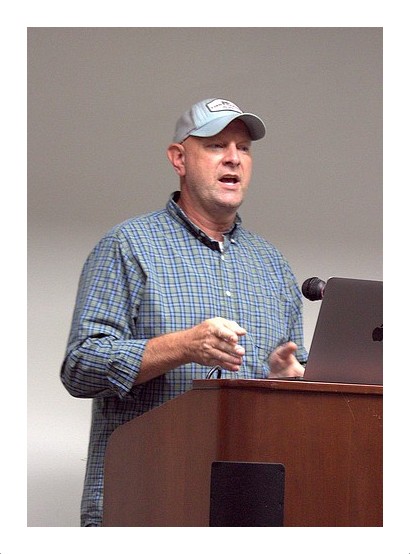
Brian began with a history of how chimneys were developed and brought to North America by European settlers. Chimneys were developed as a method to prevent smoke from filling two story homes and prevent wood floors from catching fire. Native American farming practices, along with European settlement, drastically changed the Eastern Coast of North America, home to Chimney Swifts. The Chimney Swift population was originally believed to be sparce and centered around old growth forests, as Chimney Swifts once preferred to nest in large, hollow cavities in trees. With the removal of old growth forests in the East, Chimney Swifts began to adapt to using chimneys as alternative nesting sites. By the 1920s, Chimney Swift populations centered around urban locations, rather than forests.
Chimney Swifts are insectivores, using their large eyes to spot insects and their aerodynamic wings to fly at high speeds to catch them. They have bristles on their tails that allow them to perch on vertical surfaces, as their feet are not adapted for perching. Collecting small twigs with their mouths, they use their saliva to glue together their nests on the walls of rough surfaces, like the inside of trees, caves, and ceramic chimneys.
Chimney Swifts were originally thought to be closely related to swallows. The first known illustration of Chimney Swifts was by Catesby in 1748, known at the time as the "American Swallow." Throughout the 1700s and 1800s, the species was referred to by several names, such as, "Swift," "House Swallow," "American Spinetail," and "Chimney Bird." English American botanist and zoologist Thomas Nuttall coined the name Chimney Swift in 1840, which was approved by the American Ornithologist Union in 1886.
It is believed that Chimney Swift adaptation to nesting in urban environment dramatically increased their population. However, throughout the 20th century, changes in technology of chimneys and use of insecticides have been reversing this increase. The use of narrower terra cotta liners has prevented the needed space for Chimney Swifts to enter a chimney. Building codes in some areas have led to spark arrestors and pest control screens, that block access to chimney entrances, have also reduced nesting locations. By 2019, it was estimated that only 39% of new homes had chimneys, with many of them lined with aluminum or stainless-steel surfaces, to which swifts cannot attach nests. Overall, it is believed that Chimney Swift population has decreased 2.5% per year since the 1950s, with a total decrease of 67%. An additional 50% of the population today is believed to be lost in the next 27 years. Consequently, Chimney Swifts are considered a "tipping point species," which need more research into the causes of their decline and immediate conservation action.
In 2012, Brian Shema read a book by Paul and Georgeon Kyle of Travis, Texas, on building artificial wooden chimneys, as an alternative nesting site for Chimney Swifts. After building his first chimney in the parking lot of Beechwood Farms Nature Reserve, he found it occupied in the following year. ASWP built additional swift towers at Beechwood Farms and Todd Nature Reserve and found mixed success in their use. Brian began writing grants to get additional support for Chimney Swift conservation. He wrote a Spark Grant to install a swift tower at Shaler High School, which included a built-in camera for student observation. In 2016, ASWP pledged to install 100 towers by its 100th anniversary. Contractors were hired to install these towers in nine Allegheny County Parks.
Since their installation, the Chimney Swift towers were monitored by county park rangers and volunteers, and by 2023, this monitoring program concluded that 51% of towers were occupied with nesting Chimney Swifts. Throughout ASWP's Chimney Swift program, Brian continually received questions from other bird conservation groups around the United States and Canada asking about his findings and suggestions on struggles they were experiencing with their own artificial towers.
In order to better understand the variables that might be affecting the success of an artificial Chimney Swift tower, Brian wrote a grant through the National Fish and Wildlife Foundation and the Urban Bird Treaty program to perform more detail observations of ASWP's tower collection and create a publicly accessible how-to video and instruction packet.
In the breeding season of 2025, Research Technician Meghan Phillips measured 72 variables related to 100 identical towers in the county parks. Some variables measured included elevation, daily sunlight, canopy cover, distance to tree lines, forest composition, temperature inside and outside of towers during daytime and nighttime, distances to bodies of water, distances to man-made features, and access to traditional masonry chimneys. In addition, the number of towers occupied with nests was measured.
In the study, Meghan found that 78 out of 100 towers were occupied with nesting Chimney Swifts, a much higher percentage than previously observed. Fifty-one towers contained evidence of more than one historical nest, with five towers showing a history of five nests. This showed that many of the towers were used multiple years. The study, however, showed that the statistical analysis of the 72 variables tested and 28 multi-variant tests showed no correlation with the success of used towers versus unused towers. Consequently, additional research is needed to determine ideal artificial nesting environments for Chimney Swifts. Anecdotally, Brian sees the study as showing that perhaps Chimney Swifts are not picky when it comes to the location and surrounding landscape of where towers are installed in this area. The study showed that 0% of the towers installed in two parks were successful — Boyce Park and Round Hill Park. It is unknown why Chimney Swifts have not begun using these towers.
In 2026, Brian began work with Carnegie Mellon engineering students to seek their input on designing a more homeowner-friendly version of an artificial Chimney Swift tower. The cost, weight, and steps needed to build a traditional wooden structure that Brian adapted from the Kyle's original designs is a barrier for expanding this conservation program to the backyards. Brian has challenged CMU students to design an affordable, durable, and easy to put together IKEA-like design. This project is currently underway.
Brian took questions from the audience. He explained that ASWP towers are built for nesting, with usually one pair nesting in the towers at a time. He does not have evidence of them being used by large numbers of swifts during migration. He stated that maintenance of ASWP towers is low, and that detritus at the bottom of towers often needs to be cleaned out to observe swift nests from underneath the tower. It was stated that England has required new construction homes to include a brick with a hole for Common Swift to nest in. Perhaps an artificial chimney could be a requirement for homeowners in the future. Brian explained that the height of an artificial chimney seems to be less important than the swifts having five to six feet of depth to fly in and cling to the inside walls of the chimney. A member asked about the lack of Chimney Swifts using artificial nesting sites in Boyce Park and Round Hill Park, and Brian postulated that perhaps the social nature of Chimney Swifts and a possible natural void of swifts in that area has not caused an existing population to switch over to using these towers.
Upon completion of questions, President Mike Fialkovich thanked Brian for his presentation, and the member meeting was concluded.
— Summary prepared by Dan Mendenhall on November 2, 2026


